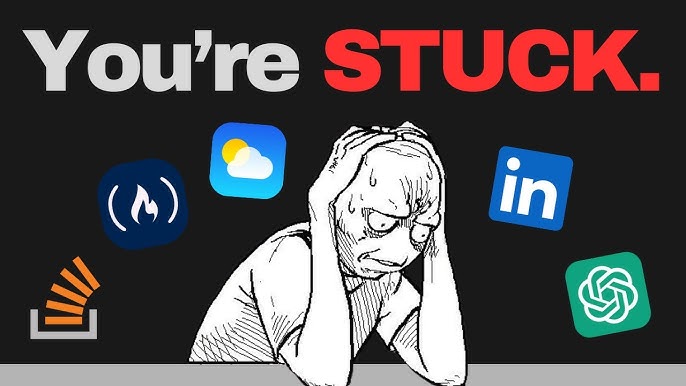
Why Most Beginner Developers Stay Stuck

Why Most Beginner Developers Stay Stuck
One of the hardest truths in programming is this: many beginner developers do not fail because they are not smart enough. They stay stuck because their learning process is broken.
That may sound harsh, but it is actually good news. If the problem were intelligence, the solution would be much harder. But in most cases, the real problem is not talent. The real problem is confusion, inconsistency, weak fundamentals, bad habits, and a constant cycle of motion without real progress.
I have seen this pattern again and again. A beginner starts learning with excitement. They watch tutorials, copy code, build small things, and feel motivated for a while. But after some time, everything begins to blur together. They know bits of HTML, a little CSS, some JavaScript, maybe a little React, maybe some Node.js, but they still cannot confidently build a complete project on their own. They start doubting themselves. They think maybe programming is not for them. In reality, the issue is often not ability. It is the path they are taking.
This is why so many beginner developers stay stuck.
The Illusion of Progress
One of the biggest traps in programming is feeling productive without actually improving.
A beginner watches three tutorials in one day and feels like they learned a lot. They read about React, then they open a video about APIs, then they jump into authentication, then they look at a few Git commands. At the end of the day, they feel busy. But being busy is not the same as getting better.
This is one of the most dangerous things in learning: the illusion of progress.
Real progress usually looks slower. It is not always exciting. Sometimes it means spending two hours understanding one concept deeply. Sometimes it means rebuilding the same feature until it finally makes sense. Sometimes it means debugging a small issue for half a day and learning more from that than from five tutorials combined.
Beginners often stay stuck because they confuse exposure with understanding. Just because you saw a concept does not mean you own it. Just because you followed a video does not mean you can rebuild it yourself. Just because something looked familiar does not mean you truly learned it.
Programming punishes shallow learning. Sooner or later, every missing foundation shows up.
Tutorial Addiction
Another major reason beginners stay stuck is tutorial addiction.
Tutorials are helpful. They can introduce concepts, show workflows, and reduce fear when something is completely new. The problem begins when tutorials become the main method of learning instead of the starting point.
A lot of beginners spend months in a cycle like this:
- watch a tutorial
- copy the code
- feel good
- start something alone
- get confused
- go back to another tutorial
- repeat
This creates dependency. The developer becomes used to being guided step by step. Every time they hit uncertainty, they need another person to tell them what to do next. That means they are training themselves to follow, not to build.
The real turning point in growth begins when a developer starts struggling independently.
That struggle matters. It is where problem-solving is built. It is where patterns become real. It is where knowledge stops being passive and becomes practical.
A beginner who spends less time copying and more time thinking will usually grow faster than a beginner who watches endless polished content but rarely builds alone.
Skipping the Fundamentals
A lot of beginners want to get to the “cool part” too fast.
They want React before JavaScript.
They want Next.js before understanding routing.
They want backend frameworks before understanding HTTP.
They want databases before understanding data modeling.
They want advanced architecture before learning how to structure basic files.
This impatience causes serious damage.
The fundamentals are not exciting because they feel simple. But those simple things are what make everything else possible. A developer who does not understand HTML well will struggle to build accessible UIs. A developer who does not understand CSS properly will keep fighting layouts. A developer who does not understand JavaScript deeply will constantly feel confused inside React. A developer who does not understand requests and responses will build backend features mechanically without understanding why they work.
Strong developers are not strong because they know more buzzwords. They are strong because they understand the basics better.
Beginners stay stuck when they treat fundamentals like a temporary stage they can rush through. In reality, fundamentals are not something you leave behind. They are something you keep using forever.
Constantly Changing Direction
Another major reason beginners stay stuck is lack of focus.
They start with frontend, then switch to backend, then try Python, then mobile development, then machine learning, then cybersecurity, then game development, then back to React. This usually does not come from curiosity alone. It often comes from frustration.
When something becomes difficult, switching topics feels easier than facing the difficulty.
The problem is that growth in programming comes from staying with a challenge long enough to understand it. When a beginner keeps changing direction, they keep resetting the learning curve. They become familiar with many things but capable in very few.
There is a big difference between exploration and avoidance.
Exploration is healthy when done intentionally. Avoidance is harmful when every new topic is really just an escape from the hard parts of the current one.
A beginner who stays focused on one path long enough will almost always outperform a beginner who constantly jumps between technologies.
Fear of Building Alone
Many beginners are comfortable learning, but uncomfortable building.
They like reading.
They like watching.
They like understanding examples.
But when it is time to open a blank project and make decisions alone, they freeze.
This happens because building forces responsibility. Suddenly there is no tutorial to follow. No one is telling you what folder to create, what component to write first, or how to fix the bug in front of you. Now it is your project, your architecture, your confusion, and your solution.
That pressure is uncomfortable, especially at the start.
But that discomfort is also where real progress begins.
A beginner who never builds alone never learns how to think like a developer. They only learn how to recognize code when they see it. That is not enough.
To grow, beginners need to practice making decisions:
- how to structure the project
- what components are needed
- what state belongs where
- what data to fetch
- how to handle errors
- how to debug broken logic
Even bad solo projects are valuable because they teach independence. And independence is one of the clearest signs that a beginner is becoming real.
Inconsistency
Programming rewards consistency more than intensity.
Many beginners study in bursts. They go very hard for a few days, then disappear for a week. They build momentum, lose it, return, get overwhelmed, and repeat the cycle. This makes learning much harder than it needs to be.
When you are inconsistent, every return feels like starting over. Concepts fade. Syntax becomes unfamiliar again. Confidence drops. You spend more time trying to remember where you were than actually moving forward.
This is why a smaller daily habit is far better than random extreme effort.
Two focused hours every day is more powerful than one giant 12-hour day followed by four days of nothing.
Consistency keeps your brain inside the problem space. It allows ideas to connect over time. It reduces relearning. It turns programming into a practice instead of an event.
Many beginner developers stay stuck simply because they do not stay in the game long enough, regularly enough, for the knowledge to settle.
Weak Debugging Skills
A lot of beginners think progress means learning new technologies. In reality, one of the biggest growth accelerators is learning how to debug.
Debugging is not just fixing errors. It is learning how to think.
When beginners hit a bug, many of them panic. They change random lines. They copy solutions they do not understand. They hope the problem disappears. Sometimes they ask for help before they have even tried to investigate the issue properly.
This creates dependency and weakens problem-solving.
Strong developers approach bugs differently. They slow down. They isolate the issue. They read the error message carefully. They inspect the data. They question assumptions. They test one thing at a time.
Beginners stay stuck when they treat bugs like interruptions instead of lessons.
A hard bug often teaches more than a smooth tutorial ever can.
Every time a beginner learns to debug patiently, they become more independent. Every time they learn to trace a problem instead of guessing, they become more professional.
Comparing Themselves Too Much
Comparison destroys a lot of good developers before they become great.
A beginner opens social media and sees people building advanced SaaS apps, talking about system design, using technologies they have never heard of, and moving at a pace that makes them feel left behind. This can be very discouraging.
But comparison is misleading because you are comparing your messy internal process to someone else’s polished external result.
You do not see their years of frustration.
You do not see their failed projects.
You do not see the bugs, rewrites, confusion, and self-doubt that came before the final post.
Beginners stay stuck when they let comparison turn into paralysis.
Instead of asking, “Why am I not at their level yet?” a better question is, “Am I better than I was three months ago?”
Real progress is personal. The goal is not to learn faster than everyone else. The goal is to keep moving.
Not Finishing Projects
Another huge problem is unfinished work.
Many beginners start projects with excitement but abandon them as soon as things become messy. This is understandable. The beginning of a project is fun. The middle is where reality appears. That is where bugs show up, design decisions get harder, and the project stops feeling clean.
But that middle stage is where real skill is formed.
A developer who starts many things but finishes nothing often has confidence problems later. They have a history of incomplete effort, so they do not trust themselves to carry ideas through.
Finishing projects matters because it teaches:
- how to handle messy code
- how to refactor
- how to solve edge cases
- how to clean up architecture
- how to deploy
- how to polish
You do not need every project to be huge. But you do need to finish enough things that your brain learns what completion feels like.
Beginners who finish small projects consistently usually grow faster than beginners who constantly start impressive projects they never complete.
Learning Without a System
A lot of beginners are not actually learning in a structured way. They are wandering.
They learn whatever appears in front of them next. A video suggests TypeScript, so they jump to that. A post talks about Docker, so they open Docker. Someone says GraphQL is useful, so they suddenly try GraphQL even though they still struggle with REST.
This scattered learning creates shallow knowledge and mental clutter.
Growth becomes much faster when learning follows a system.
A better path looks like this:
- fundamentals
- core language
- building projects
- framework
- backend basics
- database basics
- deployment
- architecture
- deeper refinement
The exact order can vary slightly, but the principle stays the same: build in layers.
Beginners stay stuck when they keep stacking advanced topics on top of weak understanding.
What Actually Helps Beginners Break Out of the Cycle
The good news is that most of these problems can be fixed.
A beginner can break out of stagnation by changing how they learn.
1. Focus on one path for a while
Stop trying to learn everything. Choose a clear direction and stay with it long enough to gain real skill.
2. Build more than you consume
For every hour of tutorial content, spend serious time building alone.
3. Revisit the fundamentals
Do not treat fundamentals as beginner-only knowledge. Go deeper into them.
4. Finish smaller projects
Small completed projects create more growth than endless unfinished ambitions.
5. Improve debugging
Read errors carefully, inspect values, isolate issues, and stop guessing randomly.
6. Be consistent
Steady repetition is stronger than chaotic intensity.
7. Compare less, reflect more
Track your own progress instead of measuring yourself against polished internet snapshots.
8. Accept confusion
Confusion is not failure. It is part of learning complex systems.
Final Thoughts
Most beginner developers stay stuck not because they are incapable, but because they are trapped in patterns that feel productive without producing real growth.
They consume too much and build too little.
They skip fundamentals.
They switch directions too often.
They avoid hard problems.
They compare themselves too much.
They stop before the learning compounds.
The way out is not glamorous. It is not a secret shortcut. It is a better process.
Stay focused.
Build more.
Finish things.
Debug patiently.
Respect the basics.
Keep showing up.
That is how beginner developers stop being stuck.
And that is how real developers are made.
Comments
Sign in to join the conversation.
Sign in